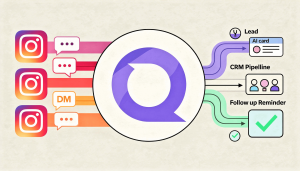
Sales in chats have long ceased to be a simple process of answering questions. What once looked like a basic dialogue with a customer has become a complex dynamic that includes dozens of touchpoints. An individual can write after seeing an advertisement, view a product page, return a week later, ask a new question in another channel, disappear again, and then demonstrate interest once more. It is difficult for managers to maintain the entire context and it is challenging for a leader to understand why some ramps move forward while others stall in the middle.
In these conditions, businesses increasingly require automation of chat based sales, funnel control, and predictable analytics. This is why companies adopt a model where the key role is performed by an AI sales manager, a system that guides the customer through the ramp, preserves context, and ensures consistent progress of deals.
What an AI sales manager is and how it differs from a chatbot
An AI sales manager is not a scripted bot. It is an intelligent agent that:
- analyzes customer behavior in Direct and messengers,
- guides conversations independently,
- works with objections,
- controls warming steps,
- updates statuses in the CRM system,
- prevents the loss of leads.
This is why it is used as the core of chat based sales rather than a basic automation tool.
Visibility of the customer path. How the AI sales manager builds the ramp map

In every dialogue the AI system reads all customer touchpoints: which advertisement brought the user in, what message was written first, which pages were viewed, which materials were opened, how quickly the person responded, and what was asked earlier. Based on this, the system builds a ramp map that shows what influences this specific customer the most.
Some individuals require social proof, others need a clear explanation of value, others need comparison of options, and others require access to a demo. The warming sequence is always different, therefore the AI system builds it based on actual behavior rather than a predefined template.
This creates the effect of a complete sales funnel inside chat platforms, where every touchpoint has its purpose and logic.
How MyChatBot in SaaS reduced the path to purchase by forty percent
The SaaS company received a consistent volume of inquiries, but the customer journey stopped at the same point. Individuals reached the tariff comparison step and then stopped responding. Managers did not have enough time to explain the difference between the packages, therefore many leads were lost at this exact stage.
The MyChatBot AI agent identified this point as the main factor that reduced conversion and began sending micro demonstrations, real examples of product usage, and short explanations of which tariff matched the specific request. Within several weeks the average decision time decreased by almost forty percent and the share of leads that converted to paid subscriptions began to grow steadily.

This case demonstrates how automated warming increases sales even without changes in traffic volume.
Individual warming dynamics
In traditional work managers often either overload the customer with information or respond too briefly. As a result, a person either loses interest or does not understand what step should be taken next.
The AI system works with the ramp more precisely. It recognizes what the customer already knows, what causes doubt, what strengthens motivation, and which formulations reduce barriers. This creates a sequence where every step feels natural and connected to the previous one.
The AI system can begin with a short explanation of the product, then add an example of usage, then present arguments or comparisons, and then guide the person to a final decision. This type of warming increases readiness to purchase without pressure.
Case two. Online school. Personal recommendation and an eighteen percent increase in conversion
The educational project noticed that individuals who contacted the school for the first time were often confused by the number of courses. They did not understand where to begin and whether the program suited their goals.
The AI sales manager started asking questions about experience and objectives and then created a personalized recommendation that included sample lessons and benefits relevant to this specific customer.
As a result, the conversion from the initial dialogue to the next step of consultation and payment increased by an average of eighteen percent.
The AI system became part of a consultative sales process instead of being a simple automated reply.
Quality of sales. How the AI sales manager helps leaders identify weak points in dialogues
In the sales process the most difficult aspect is to control the quality of dialogues. Managers can respond in different ways, change tone, skip important clarifications or miss opportunities to provide strong arguments. In Direct and messaging platforms this is especially visible since dialogues are short, fast, and not always structured.
The AI sales manager provides insight into how objections are handled, which formulations work better, and how customer trust changes depending on communication style. For the first time, leaders can scale the strongest scenarios and fix weak spots in the funnel.
Case three. A twenty four percent increase in sales without additional traffic investment
The accessories ecommerce store received a consistent stream of inquiries, however sales did not match demand. Within the first two days the AI sales manager revealed that fifty seven percent of conversations ended after individuals asked about product availability. People needed guidance and specific options, but managers simply sent a catalog link.
The AI system began asking clarifying questions about budget, style, and use case, after which it offered two or three relevant options instead of a general catalog. After the first week the share of completed dialogues increased from thirty two percent to fifty three percent. Within a month sales from Direct and messaging platforms increased by twenty four percent without any additional advertising budget.

Technology and team. Why a business needs an AI sales manager in its sales structure
Managers remain essential for complex negotiations, non standard situations, and the sale of complex products. However, the routine stages that occupy most of the time, such as initial responses, warming, repeated touchpoints, and ramp management, can be performed by the AI system without loss of quality.
As a result, the sales department stops functioning as a group of individuals with different styles and becomes a system where the AI sales manager sets a unified quality standard, controls the dynamics of the ramp, and ensures consistent movement of deals.
We will demonstrate how the MyChatBot AI agent processes inquiries, guides the ramp, and increases conversion at every stage of the sales process in your business.