A successful first contact in 2025 is no longer a technical event. It’s a psychological moment that depends on when you reach out, what tone you use, which channel you choose, how natural it feels — and whether the person understands why you’re reaching out right now.
That’s why companies today don’t really compete for clicks — they compete for attention. It doesn’t matter if you’re in e-commerce, SaaS, or services. People ignore bulk campaigns, distrust templates, and don’t want to feel like just another record in your CRM.
Over the last few years, brands have collected massive contact bases: past buyers, webinar attendees, trial users, “maybe later” requests, social followers, people who interacted with your content. But these bases stop working if you only use them for cold blasts. The “send to everyone and wait” era is over. Audiences are highly sensitive to noise, so any cold touch has to feel warm and relevant.

We can show you how MyChatBot starts smart conversations in your channels and how the platform adapts to your product and sales motions.
Why first-contact behavior has changed
To understand why MyChatBot improves conversion from “cold lists”, you need to look not at abstract attention, but at real behavior. Modern users don’t reply in some abstract “convenient time”. They respond in short windows when they’re already in contact with your topic or product.
These short windows are micro-moments. A person opens your website, returns to a product page, scrolls an old message, or opens your chat widget. In those seconds they are “in the topic”, and your outreach feels natural. Outside of those moments, almost any message feels like noise.
This is why classic cold outreach stops working. Your database can be huge, but if the message arrives out of context, it’s instantly labeled “bulk marketing”. People filter by form, not content: if it looks like a broadcast, it disappears into the feed.
Human reps can’t work at the speed of micro-moments. They juggle dozens of conversations, tasks and channels — and simply can’t always respond exactly when a person is open to talking. A reply that comes an hour later hits a different state, context and level of readiness.
MyChatBot closes this timing gap. It listens for behavioral signals, responds instantly, keeps the conversation at the user’s pace and picks up the first contact when it feels natural. The human rep steps in later — when the person is already engaged and has a concrete question or intent.
MyChatBot as a conversation model, not another blast
Unlike traditional chatbots, MyChatBot lives where people actually talk: Telegram (including personal accounts), WhatsApp, Viber, Instagram Direct, Facebook Messenger and your website. That means the first message doesn’t look like a system notification — it feels native to each channel.
On Telegram the tone is more personal, on WhatsApp it’s shorter and more direct, on Instagram it’s lighter and more conversational. But the real difference is that MyChatBot adapts not just to the channel, but to the context behind each user.
Messages are not pulled from a static template. MyChatBot uses previous interactions, purchase history, your documentation, scripts and CRM statuses. Two people with the same “tag” in your database can receive very different openings — depending on where they are active and what they did before.
That’s why MyChatBot doesn’t feel like a bulk campaign. It reaches out when the person has already shown interest: looked at a product, opened a chat, returned to your site or hasn’t bought in a while. The first touch sounds less like “marketing” and more like a logical continuation of their own actions.

Triggers: why MyChatBot messages at the right moment (not “when someone has time”)
Most companies reach out when they have resources and capacity. But users react when it makes sense to them. MyChatBot shifts the focus from “we want to message today” to “the user is now in a state where messaging is appropriate”.
Triggers are built from business rules. In e-commerce that might be seasonality, a specific product, order history or a period of inactivity. In SaaS it could be trial status, in-product activity or returning after a pause. For services it might be previous inquiries, demand peaks or a status change in your CRM.
This is not just technical logic — it’s psychology. The person doesn’t feel pressure. The message arrives in a moment that feels almost obvious.
One example: a real-estate agency had been collecting leads for two years and couldn’t tell who was back in the market. MyChatBot connected to the CRM, watched who was returning to the old landing pages and specific listings, and only then initiated a conversation. People perceived the message as a natural continuation of their own interest. Twenty-seven percent replied.
Behavior patterns: how AI acts like an attentive human rep
MyChatBot analyzes not only what people say, but how they respond. This lets the platform shape the conversation so it feels natural instead of scripted.
If a person replies quickly and in detail, the AI moves to clarifying questions. If the response is cautious or very short, the system lowers the intensity and gives more space. If there is no reply, it doesn’t push aggressively — it comes back later with a different angle or a helpful clarification.
You can see this especially well in SaaS. A user signs up, tries a few features, then drops off. Seven days later MyChatBot doesn’t just say “Upgrade now”. It asks what they were trying to do and at which step they stopped. Then it highlights the relevant features and offers short instructions, using your product docs as the source of truth.
As a result, some “sleeping” users return not because they were pushed into a sale, but because the system helped them finally complete the journey they started.
Real-life stories: three first-contact case studies
E-commerce: bringing past buyers back with a personal tone
A women’s fashion store had built up a two-year customer list. Email campaigns barely moved the needle. MyChatBot reached out to past buyers in Viber and Telegram, not as a “brand newsletter”, but as a personal stylist-like assistant.
The tone was soft and helpful: offering to pick outfits for upcoming occasions, not just pushing discounts. It felt like a dialogue, not a promo blast.
SaaS: recovering subscriptions through dialogue, not pressure
A SaaS product struggled with trial users who never converted. They didn’t react to emails or push notifications. MyChatBot reached out with a short, specific question: what exactly stopped them from moving forward.
People responded because they felt heard. The AI then pointed them to the features that matched their use case and showed how to use them.
Real estate agency: reactivating “forgotten” leads
A real-estate agency had a large list of people who once searched for housing and then disappeared. MyChatBot started conversations only when those people revisited old listings or came back to the website.
The outreach felt relevant and timely instead of intrusive.
All three stories show the same pattern: the critical part is not just launching the first touch, but how you finish it. In each scenario, the conversation was handed over to a human rep at the moment when the person was actually ready to talk. MyChatBot doesn’t replace people — it makes their work much more effective.
What’s happening “under the hood” of MyChatBot
Behind the friendly tone, MyChatBot is powered by a complex stack. But for the business it looks like a simple, structured conversation.
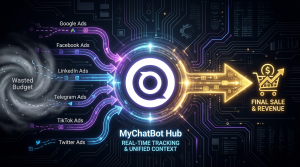
Inside the platform there is a “context layer” that connects CRM data, message history, business rules, your knowledge base and communication scripts. The AI runs on top of this layer and sees each contact not as an ID, but as a person with a specific path.
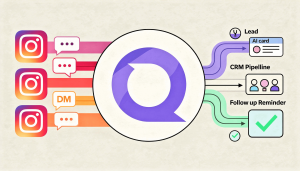
When MyChatBot starts a conversation, it doesn’t pull one static script. It reads the context and adapts the phrasing: it remembers how this person responded before, what they asked about, and which style worked better. For product questions, it pulls from your documentation. For conditions and policies, it stays inside the rules you set. When deeper consulting is needed, MyChatBot opens a lead in the CRM, attaches the full conversation history and hands it off to a human.
The platform doesn’t just “chat”. It sets labels, updates statuses, schedules follow-ups, unifies all channels in one inbox, works 24/7 and doesn’t “lose” users, even if they reply three days later.
In the end, it creates the feeling that your business is paying close attention. And users feel that — even though AI is doing most of the work.
We can walk through your pipelines, contact bases and channels and show how first contact becomes a natural, high-intent conversation instead of another campaign.
The future of outbound: precision, not volume
MyChatBot doesn’t just make outbound cheaper. It makes it precise. The platform works in the channels where your users are active, reacts to real behavior, avoids long gaps and hands over conversations when they’re already warmed up.
This helps you revive old customers, bring back people who haven’t purchased in a while, and close warm opportunities faster. Outbound stops being a lottery with bulk campaigns and becomes a controlled process where every touchpoint feels relevant.

Get a demo or launch AI agents in 1 day
Request a live demo and we’ll show how the platform can:
- start first contact at the right moment
- adapt to your product and niche
- match your brand voice and tone
- collect context and pass it to your sales team
- unlock revenue from contacts you considered “dead”
We can connect an AI agent in just 1 day and start real conversations as early as this week.