
When one bot is the bottleneck
If your Telegram channel is growing faster than your team can reply, the audience is rarely the problem. The bottleneck is the single bot standing between them and you. Past a certain number of live conversations, replies start lagging, the button menu stops covering what people actually ask, and good leads go cold in a backlog nobody has time to clear.
You feel it before you can measure it. Subscribers ask the same product question three different ways, someone finally answers the next morning, and the buying moment has passed. Demand is not the issue; the channel simply cannot carry it in its current shape.
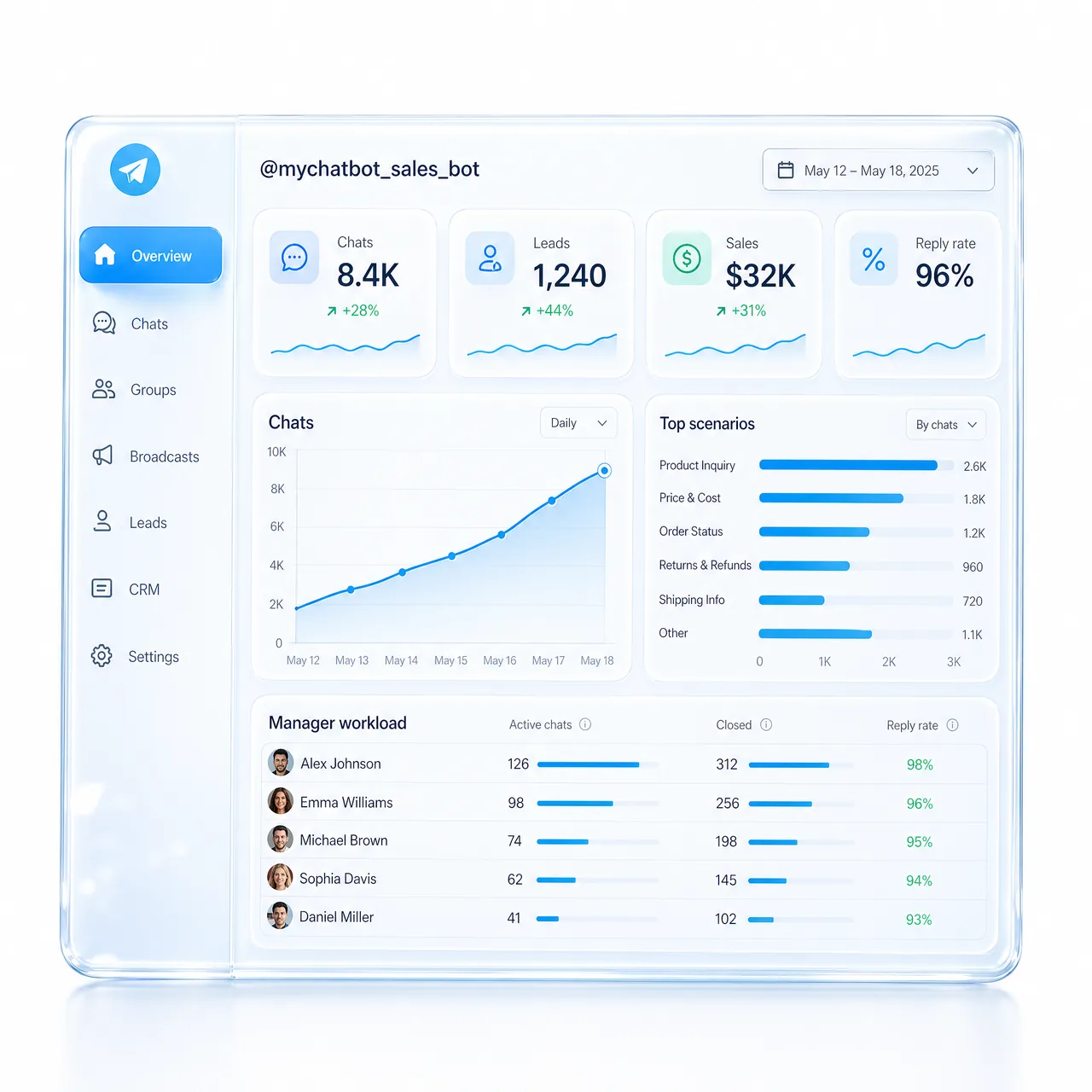
Split the funnel across focused agents
Instead of one bot trying to do everything, run several MyChatBot agents on the same Telegram bot and channel, each with a narrow job. A top-of-funnel agent takes new inquiries and replies to broadcasts. A sales agent qualifies and closes in chat. A support agent picks up after the purchase, for order status, delivery and returns.
Give all of them one shared Knowledge Base: Business Domain docs for policy and tone, a Product Feed or Product Spreadsheet for the catalogue, and Agentic Search so an agent can find “the one from the last post, but cheaper” without a menu. Because the source is shared, the voice stays consistent from the first message to delivery, and a wrong answer gets fixed once rather than in three places. Use the Configuration Wizard to assemble each instruction, battle-test it against real questions, and version it before it goes live.
How the ceiling comes off
Agents answer in natural language the moment a message arrives, so the number of simultaneous conversations stops being a constraint on your calendar. A broadcast is no longer something you brace for: replies to it land in the same pipeline and get qualified as they come in, instead of piling into an inbox you will get to tomorrow.
Every interested contact becomes a tracked lead rather than a notification you scroll past. The agent writes the record with create_crm_lead, attaches a lead_chat_link so anyone opening it can read the actual conversation, and tags the source as “AI-” so you can tell later what the agent brought in. Follow-ups pick up the people who went quiet, with a scheduled nudge that references what they asked about rather than a generic blast. When a conversation needs a slot instead of an answer, Google Calendar tools check free time and book the event inside the chat.
One CRM behind every channel
MyChatBot runs 20+ channels into one place, so someone who arrives from a Telegram broadcast and later writes to you on WhatsApp or Instagram is one record, not two. Whoever picks up the thread sees the whole history, what was asked in the channel, what was quoted, what was promised, through KeyCRM, SalesDrive, Bitrix24, Kommo, HubSpot or whichever CRM you already run.
Set the agent schedule with Agent On/Off so nothing answers in a voice you would not use at 2am, and keep Flight Control notifications going to a Telegram group your team already watches. Hand-off Control routes the high-value chats to a person through those same notifications, with a stop word or a silent hand-off when a customer asks for a human, so your team steps in exactly where it adds value.
What changes in practice
None of this makes your audience bigger. What it changes is how much of that audience you can actually talk to. Conversations that used to sit unanswered get answered, contacts that used to be a notification become a lead with a name and a history, and the ones that need a person reach a person while they still care.
To set it up, start narrow. Connect the Telegram bot, build the Knowledge Base out of the questions you already answer most often, and put one agent live on top-of-funnel only. Read a week of real transcripts, correct what the agent got wrong in the Knowledge Base rather than in ad-hoc instructions, then add the sales agent, then support. Turn on Follow-ups and Labels & Statuses in Lead Processing last, once the answers themselves are solid.
A real customer story on this: From 4-hour reply times to 2 minutes, at 13k SKU scale.