
Commands, free text, and groups in one brain
A Telegram bot has to handle three modes: /commands, free-text DMs, and noisy group chats where it should mostly stay quiet. A flat prompt treats them all the same and gets every one wrong, answering in groups it should ignore, or forcing free text through command logic. Architecture is what lets one agent behave correctly in each mode.
The four layers
MyChatBot agents stack in layers. System sets identity, tone and when to stay silent. Role narrows the job, sales, support, community, and several can run per bot. Memory is the Knowledge Base: Business Domain docs and a Product Feed, so answers are factual. Tools is where it acts, CRM writes, calendar, order creation. Edit the Feed and answers update; the prompt stays put.
Reading intent across modes
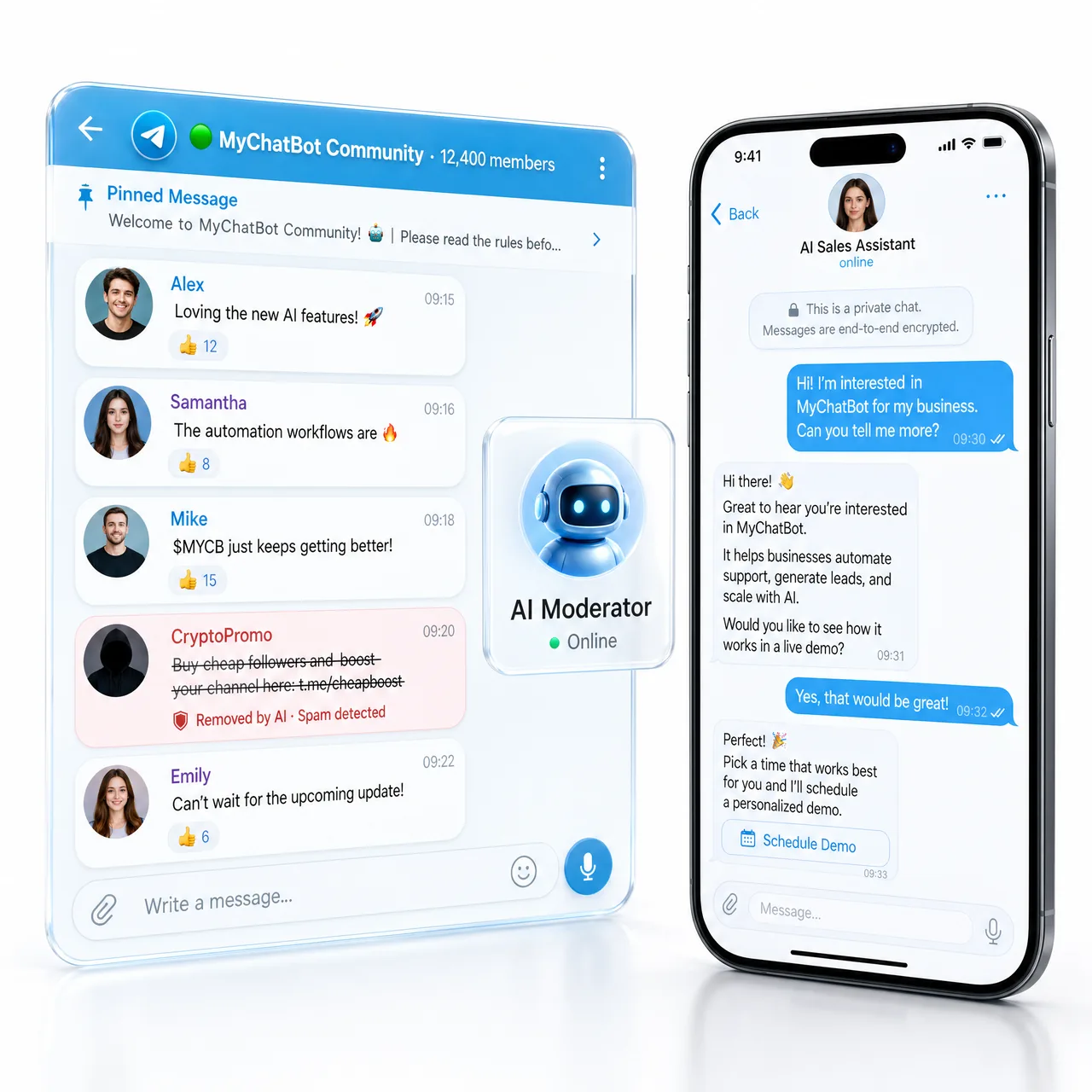
The agent classifies before it speaks: is this a command, a real question, or group chatter not aimed at it? In a DM it goes deep with Agentic Search; in a group it answers only when addressed; on a command it executes cleanly. Same brain, mode-aware behavior, that is what keeps a bot from being annoying.
What silently burns credits
The quiet budget killers: replying to every group message, re-loading the catalogue per turn, re-asking for info the lead already gave. Fix it with mode-aware silence, narrow Agentic Search retrieval, and CRM-backed memory so context persists. Architecture is cost control as much as quality.
Designing the handoff and shipping it
Hand-off Control is part of the design: define the stop-word, value threshold and emotional cues that route a chat to a human, with silent hand-off and Flight Control, fittingly, right inside Telegram. Then ship via the Configuration Wizard, which battle-tests and versions every change, so you tune tone and triggers without ever starting over.